As most gamers, I have a massive backlog of video games that I intend to play “some day", but as each year passes, that list tends to grow. No more! I intend to play through all my games, either completing them or deeming them bullshit and not worth my time. As I do so, I’ll post about said games here. They may be brandest new. They may be old as fuck. The goal is to beat 1 or 2 games a month until nothing remains of Backlog Mountain. Here goes...
Tuesday, November 12, 2013
Axel & Pixel
"Axel & Pixel is another title from the "What the hell is this?" Vault. Axel is a painter and Pixel is his dog. They get lulled to sleep by some weird ass rat creature, and in the dreamworld, they must chase said weird ass rat creature through numerous locations representing the seasons to get a key the rat's bogarting, which will unlock a door back to reality. While in this dreamworld, you try to collect tubes of paint and find vistas to sketch in order to finish a painting out in the real world.
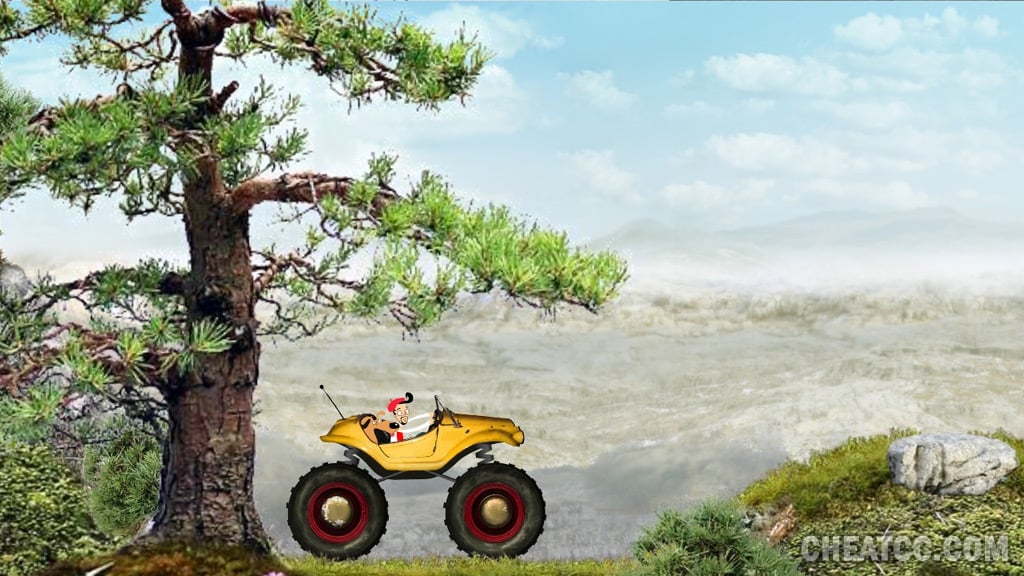
They call it an adventure game, but I contest that it is not. It's more like a hidden object game. You're presented with a scene, and you mouse over things until your cursor changes to a hand, indicating you can interact with the object. You click it, things happen, and new things will become glowy and clickable as a result. To break up this gameplay, there are a couple odd mini-games thrown in between scenes, one where you navigate a hot air balloon through a cavern, one where you drive a monster truck over hills and across gorges, and a third where you navigate a sailboat down the river, avoiding whirlpools.
It's a fairly odd game. The art style reminds me of Terry Gilliam's animations in Monty Python because it looks to be composed of existing images that have been Photoshopped together to make a scene. Axel and Pixel themselves are drawn, and there's a few 3d creatures thrown in there, but for the most part, it looks like someone went to town with some scissors and paste.
The audio might be the most enjoyable thing to me just because it's weird. There's no dialogue, but Axel does talk...but they're like nonsense sounds. Things like: Ahhhya! Oh ho! Aww doh doh. Aidoh! It's weird, but you get the meaning behind the sounds based on the inflection of his voice. This game was made in the Czech Republic, so it was definitely easier to merely translate the sparse text to whatever language rather than bother with getting a voice actor for each language.
I went through the entire game in less than 3 hours. When I got to the end, and Axel starts painting a scene of the four seasons, there are holes not filled in. He starts to pin up sketches he took during the game and fills in those holes. I missed one... Whoops. He then starts to paint. He can only paint three of those sketches. I missed lots of paint tubes... Text then appears on screen telling me that Axel didn't finish his painting, and then the credits roll.
...
Listen, Axel and Pixel. You were fine for a distraction from a boring day at work, but you're not nearly fun enough for me to go back and find all those paint tubes. I don't care that much. I figured I'd just watch the ending on Youtube. I find two people who have posted video playthroughs of the game, and much to my dismay, neither of them finished the painting either. Consensus: Axel and Pixel is not actually fun enough to finish.
It's not hard. I could probably do it in another 20 minutes, but it's not worth it. If I hadn't gotten this game in a 2K Bundle during a Steam Sale, I probably never would have even known about it, but now that I do know about it, it's not something I would have paid for on purpose. It's fine for a three hour distraction, but I wouldn't classify what I experienced as fun.
Sunday, November 10, 2013
A Virus Named TOM
A Virus Named TOM? what the fuck is that, you say! Exactly. I didn't know either. I got it in one of those Humble Bundles as a tag along. Pleasant surprise, though, it's pretty enjoyable! I had no idea what to expect going in, but A Virus Named TOM is a puzzle game. It takes place in this futuristic world where Dr. X has created such things as robo-dogs and moving sidewalks everywhere so walking isn't necessary. But then he created a giant people killing robot to make sure people were using his inventions, and that seemed kind of too far. As a result, he was fired. Like most crazy mad scientists types react when fired, he wants to watch the world burn, and thus, TOM was created.
The good doctor then sics TOM on each of his inventions in turn, until they're reduced to malfunctioning scrap piles. He does this by helping the virus spread in multiple levels of each invention. That's where you come in. In each of these levels, there's a main source of the virus that you're trying to spread throughout the entire circuit by matching up ends of differently shaped circuit segments. Each of these segments can be rotated, and the goal is to rotate the pieces so they make a complete circuit. In a complete circuit, the green virus is glowing in every piece, and there are no remaining grey non-infected pieces. The gameplay kind of reminds me of the hacking mini-game in Saint's Row IV, except way more stressful.
The stress is a result of both the level being timed, the possibility that you can run out of energy, and that there are anti-virus drones of various kinds roaming around that can kill your virus spreadin' ass. It's fun and stressful and caused me to shout many expletives at my screen. It remained enjoyable though because each level is a little bite size chunk that you can jump in and tackle even if you only have a couple minutes to play.
At times, it got slightly too stressful, and I needed a gameplan in order to tackle a puzzle. This may seem like cheating, but I contest THAT IT IS NOT! I would take a screenshot of the field of play and work it out outside the game in Microsoft Paint. "I'm still using my brains. I'm still solving the puzzle. It is not cheating.", I say to all the people that saw me drawing on my screenshots and proceeded to accuse me of cheating. You don't know what it's like in there! Don't judge me.
A Virus Named TOM was very entertaining to me. I could tell my brain was working out some of the levels long after I stopped playing that day, and I'm preeetty sure I even had dreams where I was solving these puzzles. All in all, pretty good for a game I essentially got as a free Humble Bundle bonus.
Saturday, November 9, 2013
BRAID
I'm having a hard time putting into words my experience with Braid. There were parts I liked, parts I didn't, and parts I just thought were being vague and ambiguous for the sake of being vague and ambiguous. But I'm getting ahead of myself...
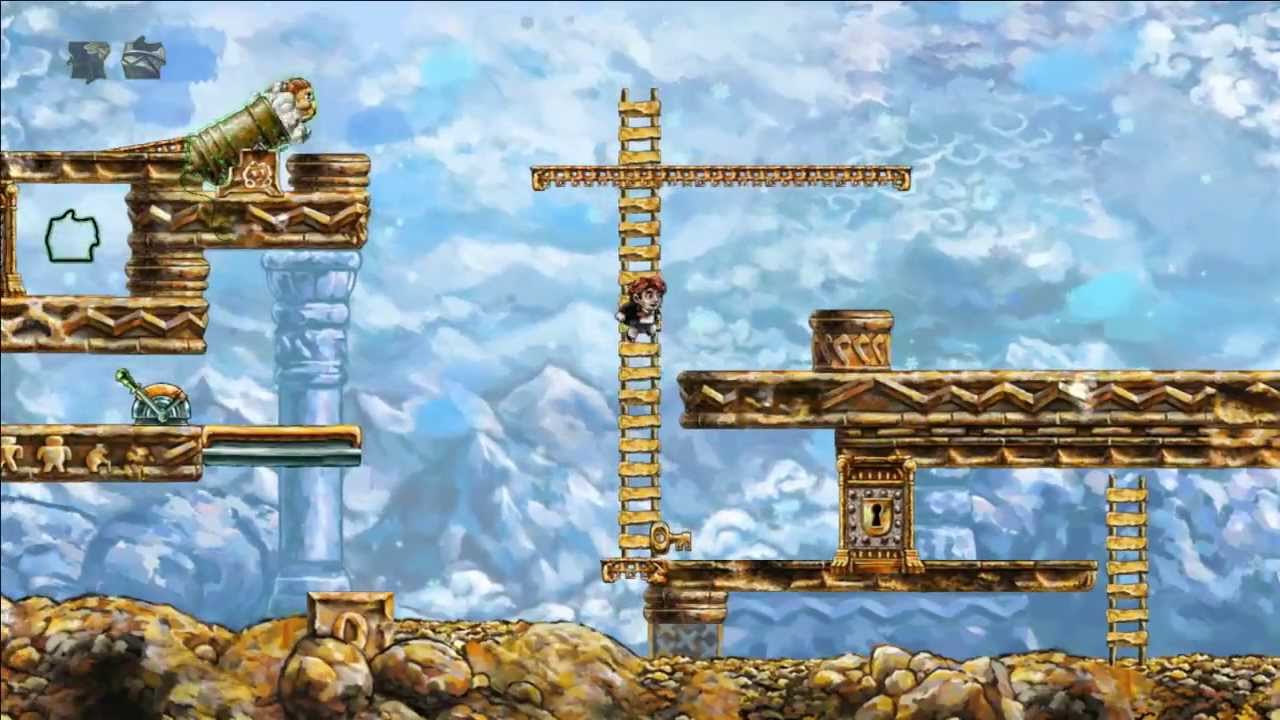
Braid, as I'm sure you know, is an indie puzzle platformer sprung from the mind of Jonathan Blow. The main mechanic this game is built on is the manipulation of time. While in Super Mario Bros, you'd fall in a hole to your death and have to start the level over, Braid gives you the power to rewind time. At the point of would be annihilation, you can rewind prior to the point you flubbed up and give it another go.
The game is broken up into six separate worlds. These worlds are accessed via a house interior, where each door leads to one of these worlds. You only have access to Worlds 2-6 downstairs. World 1 is accessed through the attic, which is inaccessible at the beginning due to a broken ladder. You will gain rungs to this ladder as you finish all the puzzles in each world. As you enter a World's door, you proceed to a cloud scene in which there are a number of books and multiple doors present. Walking in front of each book will display text on the screen, which is about our protagonist, Tim, and a relationship that seemingly went south. Each door available leads to the individual levels of that world. In each level, there are puzzle pieces scattered about, and you must figure out how to use the environment and your ability to rewind time in order reach the puzzle pieces that are enticingly close but always seem to be just out of reach.
My first experiences with acquiring puzzle pieces were very...let's say inefficient. I would see a piece and have no idea how to get to it. I'd try a couple things, fail miserably, and move on to the next puzzle piece and/or level. I appreciated the fact that no level really forced you to accomplish everything, or really anything, before you could leave for the next level. This was good because I wasn't really grasping the rewind mechanic at all due to my impatient mood that day.
I think I yelled, "THIS IS IMPOSSIBLE!" at one point. Then I calmed down, realized I wasn't just going to tear through this game, and started using my noodle. I had a breakthrough in which I realized the very simple concept that jumping on a baddy from a high place made me jump higher. That led to solving numerous problems, getting a bunch of puzzle pieces, and the acceptance that I was just being an impatient asshole shouting about impossibility. Figuring one of these puzzles out when it had been stumping you is a very satisfying experience. I kept having the same experience in each world where the puzzles made me feel like a fucking idiot and then a fucking genius and then a fucking idiot...
Everything in Braid tends to have a purpose. There's not really any superfluous platforms or other bits in the environment that aren't somehow involved with the puzzle. If it's there, I'm probably supposed to do something with it. This logic helped me figure out some of the puzzles because when a solution was not readily apparent, I started to breakdown all that was at my disposal, trying to figure out what purpose everything served. This exacting way he created the game world meant that everything was important but also that there was a single specific solution to every problem. There was one right way to do things, and sometimes that one way was difficult to figure out. Sometimes the timing or my position was so critical that I had to try over and over, despite the fact that sometimes, I totally understood the puzzle and how I should be able to complete it. My execution of those steps was sometimes the hinderance, and that was occasionally a source of frustration. The level "A Fickle Companion" drove me nuts for this reason. I think I consulted a Youtube video for that one because I failed so many times that I assumed I must have been taking the completely wrong track. Nah...I was right, I just needed to time everything better or stand a few pixels to the right. Infuriating.
As I continued through each world to pick up puzzle pieces I missed, I reread the text each time. I wasn't really grasping how the text and gameplay related. There seemed to be a bit of a disconnect both with the game and the text and between texts themselves. However, I later realized that each bit of text foreshadowed the new wrinkle in gameplay that was to be added in that world. For example, the first world you enter, World 2, talks about forgiveness and learning from mistakes. This seems like an introduction to the rewind mechanic in general. In World 6, there's much talk about a ring, and the new gameplay ability involves a circle you can deploy which slows down time within that circle.
I continue to backtrack and pick up missing puzzle pieces. Collecting all the pieces in each level allows you to put together the whole puzzle for that world, and once that world's puzzle is completed, the ladder extends further to the attic. Once Worlds 2 through 6 have been taken care of, the ladder is complete, and I proceed to World 1. In order not to rob you of your aha moment here, I'm gonna be Lady Vague. World 1 is likely the most stressful. What once were puzzles meant to stare and ponder on must now be solved quickly as you rush forward to save the princess and escape the fiery inferno that blazes behind you in hot pursuit. (Accidental pun...sigh) When you make your way to safety, that's when the game changes, and your perception of events gets turned on its head. You understand your role in this story much clearer now, and I think I recall a "whoa" falling out of my mouth.
After this realization comes the epilogue, complete with more books and text, more indecipherable now than ever. What was contentment regarding this game's ending swings over to bafflement. The game is over, and I'm left scratching my head. I assume there is some deep meaning hidden in those final words that this pleb isn't going to get, so TO THE INTERNETS THEN! My biggest aha/whoa moment was that realization at the end, but Jonathan Blow contends that this wasn't the point of the game. Oh...well... Tell me what the point was, internet. What does it mean? There are lots of discussions going on regarding this topic, but Mr. Blow says we're all pretty much wrong about what the game means, but he smugly refuses to tell us what the game means because it cannot be explained with words, which is why he made the game, which, don't forget, we were all just apparently wrong about the meaning of. Great... Glad we cleared that up.
I don't think we'll ever uncover all that the creator intended in Braid, but that's okay. When one takes away meaning from a piece of art, there is no right or wrong interpretation. That was YOUR interpretation. I think that's what has always annoyed me about comparative lit or art appreciation. There's no RIGHT answer, and I have to get over that. I think Jonathan Blow needs to get over that as well.
What I do know is that guy who made this game is a clever dude. There's some very well designed puzzles in Braid. There's also some not so good ones peppered in there with one time use mechanics or "Gotcha bitch!" traps, but it's worth taking a look at. I think any game that causes this much discussion and wildly different opinions on it has to be experienced oneself. Go get your own interpretation. Dear Jonathan is not going to clue you in on which one you SHOULD have.
Tuesday, November 5, 2013
The Secret of Monkey Island: Special Edition
I love the Monkey Island franchise. I've beaten most of them, save the new Telltale Games episodes, but it's been so long, I've forgotten...you know, everything. Thus, a Special Edition of "The Secret of Monkey Island" was the perfect excuse to revisit the series.
If you've been living under a rock and know not of Monkey Island, just know that it's a point-and-click adventure game following around Guybrush Threepwood, mighty pirate...or wannabe might pirate. It's funny, awesome, inspired loads of adventure games that were to come, and you should go and play it already, you gutter-crawling cur!
Sorry, been insult sword fighting today.
What makes this a Special Edition was that they went back in and remade all the backgrounds and characters to be all fancy and drawn lookin'. They also added voice actors to do all the dialogue. While I really liked the addition of voice actors, the new art lost some of the charm for me. I wanted to experience it now as I did then. Thankfully, they gave me that option. Pressing F10 toggles between original and Special Edition looks.
It was a very bizarre way to play this game, but each time I would enter a new screen, I would switch over to the Special Edition and take note of the updated graphics. They very faithfully recreated the old scenes, but I would immediately then switch back to the old look. It's like a comforting blanket, the old graphics. The new backgrounds looked pretty good, but I really didn't like the look of Guybrush himself. He's too lanky or something, he's got a dopey haircut, and his walk animation looked too...smooth. It was as if he floated over the ground rather than was actually walking on it. And since I'd have to look at that gangly mook the entire time, I took Mr. Pixel instead.
I also didn't bother to figure out the new controls. The Special Edition utilized a hidden inventory and action window rather than take up the bottom half of the screen with the standard controls, but it wasn't immediately intuitive to use. It was probably designed for controller in mind, but I was using a good 'ol mouse and keyboard, and I wanted to play in old school mode anyhow, so I said fuck it.
Like I mentioned previously though, the voice acting was an excellent addition. That alone was worth the price of admission. I would walk around and use items on other items in old school mode, but anytime there was dialogue, I'd flip back to fancy schmancy mode to enjoy the audio. They brought back many of the voice actors from later Monkey Island games, which was most excellent.
If you haven't played The Secret of Monkey Island, there's no time like the present. I've loved this game for years for its existing awesome, and I love the Special Edition for allowing me to re-access that awesome without floppy disks. Kudos.
Tuesday, October 29, 2013
LOOM
Reaching back into the adventure game vault again, I pulled out LOOM. I really had no idea what this game was about going into it, and I had tried to play it once before. It was during overtime at work though, so I was probably pissed, and it wasn't the best time to try anything new. (Before you start judging my work habits, know that we were stalled with nothing to do and were waiting and waiting...and trying LOOM...and waiting.) I don't think I at all grasped what was going on in that initial playtest, and therefore, I didn't stick with it.
What got me to jump in with both feet was The Adventure Gamer started playing it recently, and in his LOOM: Introduction blog post, he made me aware of the existence of a 30-minute audio drama that came as a cassette with the game. It covered much of the backstory, setting the stage for the prologue of the game. I bought LOOM on Steam, so I had no idea the cassette even existed. The audio drama is fairly well done and uses all the voice actors from the game. You could gather the backstory from bits and pieces in the game itself, but I really enjoyed the 30-minute exposition. It pushed me to start playing immediately. Give it a listen on Youtube if you're so inclined.
In short, you are Bobbin Threadbare, a child born of the LOOM. Your mother, Lady Cygna, created you via weaving a single grey thread on the LOOM after losing yet another child. She did this in defiance of the Elders' wishes, who thought this would be playing God. This act of rebellion led them to transform Cygna into a swan, banish her for her disobedience, and left young Bobbin all alone. Fortunately, he was taken in by Cygna's friend Hetchel and raised as her own, and while she was given strict orders not to teach Bobbin the Guild of Weaver's craft, she defied that decree and taught him some simple drafts.
A draft is the weaving of threads by playing four musical notes with your distaff in a specific order to affect change in the world around you. For example, ECED is the Open draft, which can be used to open doors and whatnot. More notes become available as you progress, allowing you to play more advanced drafts that you'll learn along the way.
You'll have to write these drafts down somewhere as there's no way in-game to keep track of them. If you have the original boxed version of this game, it comes with a "Book of Patterns" to write these down in, along with some useful descriptions of the drafts that I'm sure I would have found useful in my playthrough. You can manage without it though so never fear.
Since playing these drafts is the main way to interact with objects in this game, the UI for LOOM is a tad different from other LucasArts games. You don't have an inventory, and the normal verbage of USE, LOOK, PICK UP, etc. is gone. The lower third of the screen is occupied instead by your distaff and an area to display the image of the currently selected object.
When you mouse over an object that's interactable, an image of it will appear in the lower right. Clicking on that object in the game world will keep it selected, and the image will remain in the lower right corner, allowing you to use a draft on it. Clicking on the image itself will allow you to LOOK at the object, making Bobbin say a few words about it.
These controls work well enough...but it is a minor pain in the ass that you can't look for interactable objects while walking. You have to be standing still for the images to appear. I can do two things at once, LucasArts. Let me be efficient. Navigation is also a bit odd when there's multiple planes in one scene. For the most part, clicking high or low on the screen won't make you go forward or backward in the scene. It's the left/right location that's important. In instances where there are multiple depths at which you can move, you'll have to ease Bobbin onto whatever bridge or walkway leads to that second plane because just clicking where you want him to go results in him moving to that lateral location on whatever plane he's currently on. It's odd, but thankfully only two or three scenes share this problem.
Trivial. It's fine. The important thing was that the story was interesting and kept me engaged. The backgrounds were very nice looking, and there weren't any puzzles that were so convoluted that they couldn't be figured out. I made sure to take my own advice and didn't feel rushed or antsy to finish. It isn't a very long game, making it doubly shameful to cheat and look up hints. The few times I did get stalled, I allowed myself to be stuck and came back to it later, confident knowing that it was solvable. This was because LOOM was one of the first LucasArts games to adhere to their code of not letting the user get into some unwinnable state requiring reloading from a previous save or worse, restarting the game entirely. I appreciated this change in game design ideology. It's too easy to think you screwed up in some gargantuan fashion rather than remain calm and assume you're just not trying the right things. This leads to reluctant cheating. Reluctant cheating leads to frequent cheating. Frequent cheating leads to being an asshole. Thanks for nipping that in the bud, LucasArts.
I enjoyed the world of LOOM. There were interesting characters, lore, and unique game mechanics. The game was a bit short and rather easy at times, but it was an enjoyable experience throughout. The real shame of it is that the ending is clearly open ended, setting them up for sequels which never were to be. I'm only 23 years too late, but somebody want to make that sequel? I'm ready now. Telltale Games, perhaps? Anyone, anyone? Bueller?
Wednesday, October 9, 2013
Sam & Max: Season 1
Just getting this out there... "Sam & Max Hit the Road" might be my favorite adventure game of all time. Of all my adventure games, I'm pretty sure I've replayed it the most and could very likely quote the whole damn thing. Therefore, I was delighted that TellTale Games were going to pick up the torch and bring these characters I love back to video game land for "Sam & Max: Season 1" ...or "Sam & Max Save the World" or whatever the hell they're calling it.
"Season 1?", you say. I know. It's weird. While it's not the first game to employ an episodic release, I'm pretty sure it's the first that I've ever played in that vein, and I'm a little conflicted. Instead of releasing one game that took multiple years to develop, they release individual episodes in much quicker intervals, where each episode is a part of an overarching story. Granted, I didn't really get the full benefit of the episodic nature since I played it seven years after the fact...
I was busy. Shut up.
Each episode is about two hours long. Sam and Max have a new case each episode, all which tie in together to slowly reveal the parts of a massive hypnosis conspiracy.
I feel that it took a couple episodes for the developers to hit their stride. The first three episodes feel very samey. There is essentially three rooms in which the bulk of the adventuring takes place in, plus an additional "boss" area at the end. The puzzles in those early episodes are fairly straightforward, and it's fairly obvious what an object is for once you get it. The formula for those first episodes seemed to be:
1. Notice people are hypnotized in some fashion.
2. Bosco, the Inconvenience Store owner, has an item you don't have enough money for.
3. Your adventure reveals three things you need to do.
4. Do the three things, get money and consequently the item from Bosco, proceed to "boss fight".
5. Go through the Boss Fight dialogue tree a bajillion times to find the correct combo to win.
The fourth episode broke the mold a little bit and was by far the strongest and most enjoyable. The dialogue was better overall, more..."Sam & Maxish". There were more visually interesting locations and lots of back and forth between them. Items were both more obscure in their purpose and could be used in various ways, making the solutions not so obvious. It was the first episode I had to stop and think about a puzzle for a moment. Plus, you're chasing around a giant mechanized Abraham Lincoln, which is pretty great any way you slice it.
The remaining two episodes weren't quite AS good as the fourth one, but they were still solid in that the dialogue was humorous, and the puzzles required slightly more pondering. Visually, there were additions of vehicles on the street to add a bit of life, and in Episode 6, they made it look like dusk. Not huge changes, but I like that you're trying. I also appreciated that, in the last two episodes, they wrote new dialogue for each clickable item. Every episode, I clicked on every single item in that office. Thanks for eventually rewarding me with new funny words. It made it worth it, unlike my obsessive opening of 516 toilet stall doors in Fallout 3, every time expecting a ghoul to leap out and scare the bejesus out of me. Ghoul tease...
Anyway, I enjoyed my reunion with Sam and Max overall, and I'm hopeful for the remaining two seasons. I give Season 1 a rating of...six hyperkinetic rabbity things and vow it won't take me another seven years to get around to playing Season 2.
Tuesday, September 24, 2013
FEZ
Well...I beat FEZ. I know that because credits were involved. As to what happened, what I accomplished, what the fuck that ending was about, it's hard to say...symbolism is not exactly my forte.
Let's back up for a sec though. I don't even know what FEZ is, you say. For the uninitiated, FEZ can best be described as a puzzle/platformer. The interesting mechanic that it's built around is the ability to rotate the world. Not everything is as it first appears. What looks like a 2D world is actually 3D, and Gomez, after receiving his magic fez hat, is able to rotate the world 90° left or right at will to navigate through the world. Platforming will always be performed in a 2D space, but each 2D face has three other corresponding sides that can be rotated to the foreground. Platforms, ledges, ivy to climb, etc. may not line up in your current configuration, but with a change in perspective, the way can be found.
The immediate surface goal is to find shiny yellow squares scattered around the world. Find 8 of those squares, and they form a cube. Find/construct enough cubes, and you can open certain doors around the world, revealing more of the world. The true goal is exploration and discovery. As you progress, you realize there are secrets, hidden cubes, puzzles that will make you tear your hair out, and even an entire language to decipher.
When you start playing, you're totally confused. You're also lost and can't use the map system for shit, but that's okay! Keep plugging away, and you start to understand how to get around in the world. I told one of my friends, "I don't know what the hell I'm doing, but I'm doing it better than I was an hour ago."
Whenever you actually figure out one of the puzzles USING YOUR OWN BRAIN, there is tremendous satisfaction in that. In order to have the best gameplay experience possible, I recommend resisting the urge to look to the internet for help. I did that on occasion and felt like a cheating asshole when I did. Three things to keep in mind while playing FEZ:
- Don't go into this game putting time constraints on yourself. If you think you're not progressing as quickly as your arbitrary self-imposed schedule demands, you're going to get frustrated and look shit up. Try not to look shit up.
- Know that there are some rooms that you simply cannot do anything in on your first pass. You may do something down the road that makes unlocking the secrets of that room possible. Don't feel like you can't backtrack. You're going to have to backtrack. You're not a failure if you backtrack.
- You don't have to unlock everything to see the endgame. Finding 32 cubes will allow you to "beat" FEZ, however there is a slightly different ending if you find all 64 cubes and anti-cubes. Whether or not that's worth it depends on how much fun you're having, I suppose.
Subscribe to:
Posts (Atom)