
Thursday, January 9, 2014
Monkey Island 2: Lechuck's Revenge Special Edition
I went to 1991, and I liked it there. Might as well set up camp and stick around for Monkey Island 2: Lechuck's Revenge Special Edition. This Special Edition had some nice little upgrades from the Secret of Monkey Island Special Edition. In the last one, the new dialogue audio wouldn't play if you were playing in old school mode. This required me to switch back and forth whenever I talked to someone because I enjoyed the new audio but preferred the old graphics. In Lechuck's Revenge, the dialogue plays no matter what mode I'm playing in. Most excellent.
Another neat addition was that of commentary. While playing the game, certain areas would have "Press A for Commentary" text in the corner. Pressing "A" would start a recording of the creators Ron Gilbert, Dave Grossman and Tim Schafer discussing something to do with that particular area. You get interesting little nuggets of where certain jokes or puzzles came from, interesting things about the production process, or fun arguments about such topics as: Guybrush's pants dropping in the cemetery...funny or not funny.
 There are so many reasons why I love this franchise. Anytime a game makes you laugh out loud, it's doing pretty good. Each time you grab an inordinately large item and shove it in your coat, I'd laugh. A dog, a ship figurehead, a monkey...each time..out loud. Fabulous. There was also a point where I was just trying to use all my tools on something. I tried a hammer but thought, "What I really need is a wrench." As I said this, I used the monkey I had been carrying around. It worked, and I laughed. I also really enjoyed this one bit where the room was pitch black. In order to see, I figured I'd strike one of my matches. Before I did so, I thought, "This would be the perfect opportunity for a Looney Tunes gag. I strike the match, and it reveals a room full of explosives. If one could high five a game, I would have.
I must not have beaten this game when I played it years and years ago because the ending caught me by surprise. It was kind of cool because they kept you perplexed until the end of the credits. Only then did they reveal what was really going on. All in all, Lechuck's Revenge is a fine installment of the franchise, and if you enjoyed the original Monkey Island, you'll like this one.

Friday, January 3, 2014
Out of This World/Another World
I have once again reached far back into the vault, and this time 1991 fell out. Via Steam sale + extra Steam Wallet monies from selling silly trading cards, I picked up "Another World" for a whopping .56 cents. Back when it was originally released, my brother had it on the Apple IIGS. It was titled "Out of This World" for that version, and that is what I will forever call it. Out of This World tells the story of a scientist who, after an experiment gone wrong, has been transported to another world in which he's just fighting to survive.
Finally playing it myself, it was like a blast from the past. I recall very vividly many of the scenes that played out as my brother played it. I was about 6 at the time. I had watched him play many games, but this one seems to have stuck more in my mind than the others. It had a great art style and looking at it now, it had a very cinematic feel that you just didn't see in other games at the time.
 ...or even now. This game did so much with so little. It's very impressive.
I like the fact that he, and I say he because I'm pretty sure this game was the work of one dude, Éric Chahi...I like how he used simple polygons to such dramatic effect. The monster at the beginning, for example, is little more than a black mass and a suggestion of teeth, but this suggested form is perhaps more powerful because your imagination can conjure up far scarier things to fill in the visual blanks. In a world where modern games are so obsessed with looking more and more realistic, it's interesting to see a game like this still be so successful at sucking you into this world and evoking emotions of fear, relief, camaraderie, success, and the like.
 As gameplay mechanics go, you have a small, manageable quantity at your disposal. You have basic movement of forward, back, jump, crouch, and additionally, you have a gun which, based on how long you hold CTRL, will either shoot, put up a temporary force field, or create a blast powerful enough to break small barriers. The way these limited mechanics are used seems very inventive throughout. I can't recall a game of this period that allowed you to do so much with the environment itself. The environment wasn't just a set piece. It often had to be used. What looked like decorative stalactites actually could be climbed on, a well placed superblast turned a rock formation into a handy ramp leading to freedom, and you learn that sometimes chandeliers are good for dropping on heads.
As a neat addition for the 20th Anniversary edition, there are some extra bonus features included with your purchase. They include two PDFs of design documents and a video with the creator and composer about the making of the game. Each provide an interesting look behind the scenes of this excellent title. It's been 23 years, and gladly, it still holds up. Definitely worth my .56 cents.


Monday, December 30, 2013
World of Goo
I just finished World of Goo, and while it was fun, I can't help but feel there's a lesson trying to be crammed down my throat. World of Goo at its core is a puzzle game. You have goos of varying abilities that you use to build goo structures across the level so that they reach a pipe. All goos that are not part of your structure will be sucked into said pipe. To complete each level, there is a minimum number of these unused goos that have to be collected. In each level, you have to balance building a structurally sound goo tower/bridge/blob while leaving enough goos to be collected at the end.
 Throughout the levels, there are signs present with both thinly veiled clues for how you should tackle the level and also subtext peppered in of the overarching themes and, let's say, lessons of the game. Mostly, this felt like throwaway text that I didn't really enjoy. The level design and text, though, were clearly meant to make some statement about our society. It touched on things like our ever present need for more energy, the fact that we as a society are overly obsessed with physical appearance, the destruction that is required in the name of "progress", and the fact that our online habits are constantly monitored and personal information sold in the service of marketing. That's awful deep shit for a game I just thought was a neat playground for goo physics.
I enjoyed the puzzles. They were difficult at times. They were confounding at times. The puzzles were fun.
However...
World of Goo was like a box of assorted chocolates. The puzzles were the tasty chocolate coating hiding the kinda gross center of underlying subtext. "Kinda gross" or no, I still ate the whole damn box.

Tuesday, November 12, 2013
Axel & Pixel
"Axel & Pixel is another title from the "What the hell is this?" Vault. Axel is a painter and Pixel is his dog. They get lulled to sleep by some weird ass rat creature, and in the dreamworld, they must chase said weird ass rat creature through numerous locations representing the seasons to get a key the rat's bogarting, which will unlock a door back to reality. While in this dreamworld, you try to collect tubes of paint and find vistas to sketch in order to finish a painting out in the real world.
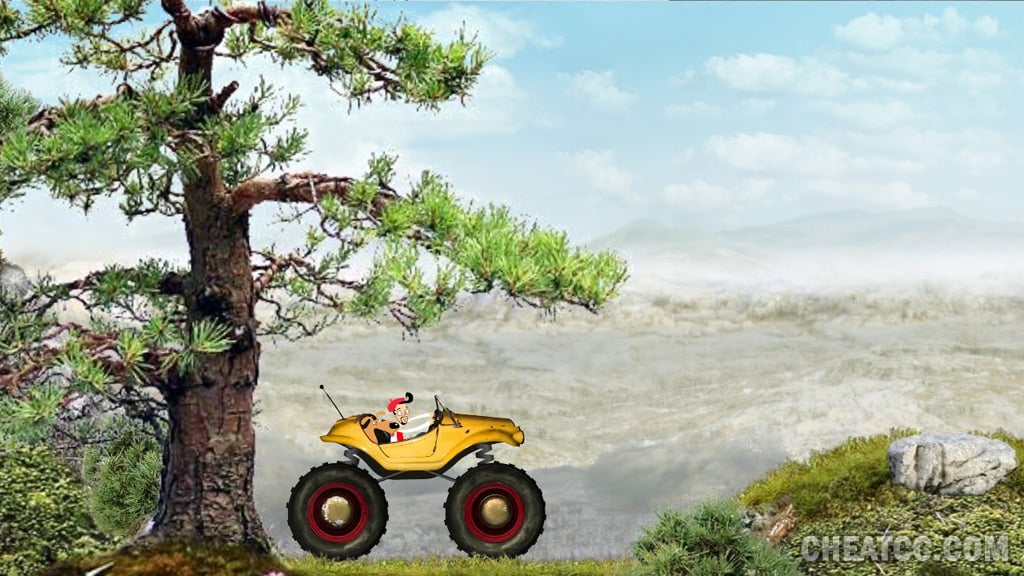
They call it an adventure game, but I contest that it is not. It's more like a hidden object game. You're presented with a scene, and you mouse over things until your cursor changes to a hand, indicating you can interact with the object. You click it, things happen, and new things will become glowy and clickable as a result. To break up this gameplay, there are a couple odd mini-games thrown in between scenes, one where you navigate a hot air balloon through a cavern, one where you drive a monster truck over hills and across gorges, and a third where you navigate a sailboat down the river, avoiding whirlpools.
 It's a fairly odd game. The art style reminds me of Terry Gilliam's animations in Monty Python because it looks to be composed of existing images that have been Photoshopped together to make a scene. Axel and Pixel themselves are drawn, and there's a few 3d creatures thrown in there, but for the most part, it looks like someone went to town with some scissors and paste.
 The audio might be the most enjoyable thing to me just because it's weird. There's no dialogue, but Axel does talk...but they're like nonsense sounds. Things like: Ahhhya! Oh ho! Aww doh doh. Aidoh! It's weird, but you get the meaning behind the sounds based on the inflection of his voice. This game was made in the Czech Republic, so it was definitely easier to merely translate the sparse text to whatever language rather than bother with getting a voice actor for each language.
I went through the entire game in less than 3 hours. When I got to the end, and Axel starts painting a scene of the four seasons, there are holes not filled in. He starts to pin up sketches he took during the game and fills in those holes. I missed one... Whoops. He then starts to paint. He can only paint three of those sketches. I missed lots of paint tubes... Text then appears on screen telling me that Axel didn't finish his painting, and then the credits roll.
...
Listen, Axel and Pixel. You were fine for a distraction from a boring day at work, but you're not nearly fun enough for me to go back and find all those paint tubes. I don't care that much. I figured I'd just watch the ending on Youtube. I find two people who have posted video playthroughs of the game, and much to my dismay, neither of them finished the painting either. Consensus: Axel and Pixel is not actually fun enough to finish.
It's not hard. I could probably do it in another 20 minutes, but it's not worth it. If I hadn't gotten this game in a 2K Bundle during a Steam Sale, I probably never would have even known about it, but now that I do know about it, it's not something I would have paid for on purpose. It's fine for a three hour distraction, but I wouldn't classify what I experienced as fun.
Sunday, November 10, 2013
A Virus Named TOM
A Virus Named TOM? what the fuck is that, you say! Exactly. I didn't know either. I got it in one of those Humble Bundles as a tag along. Pleasant surprise, though, it's pretty enjoyable! I had no idea what to expect going in, but A Virus Named TOM is a puzzle game. It takes place in this futuristic world where Dr. X has created such things as robo-dogs and moving sidewalks everywhere so walking isn't necessary. But then he created a giant people killing robot to make sure people were using his inventions, and that seemed kind of too far. As a result, he was fired. Like most crazy mad scientists types react when fired, he wants to watch the world burn, and thus, TOM was created.
The good doctor then sics TOM on each of his inventions in turn, until they're reduced to malfunctioning scrap piles. He does this by helping the virus spread in multiple levels of each invention. That's where you come in. In each of these levels, there's a main source of the virus that you're trying to spread throughout the entire circuit by matching up ends of differently shaped circuit segments. Each of these segments can be rotated, and the goal is to rotate the pieces so they make a complete circuit. In a complete circuit, the green virus is glowing in every piece, and there are no remaining grey non-infected pieces. The gameplay kind of reminds me of the hacking mini-game in Saint's Row IV, except way more stressful.
 The stress is a result of both the level being timed, the possibility that you can run out of energy, and that there are anti-virus drones of various kinds roaming around that can kill your virus spreadin' ass. It's fun and stressful and caused me to shout many expletives at my screen. It remained enjoyable though because each level is a little bite size chunk that you can jump in and tackle even if you only have a couple minutes to play.
At times, it got slightly too stressful, and I needed a gameplan in order to tackle a puzzle. This may seem like cheating, but I contest THAT IT IS NOT! I would take a screenshot of the field of play and work it out outside the game in Microsoft Paint. "I'm still using my brains. I'm still solving the puzzle. It is not cheating.", I say to all the people that saw me drawing on my screenshots and proceeded to accuse me of cheating. You don't know what it's like in there! Don't judge me.
 A Virus Named TOM was very entertaining to me. I could tell my brain was working out some of the levels long after I stopped playing that day, and I'm preeetty sure I even had dreams where I was solving these puzzles. All in all, pretty good for a game I essentially got as a free Humble Bundle bonus.


Saturday, November 9, 2013
BRAID
I'm having a hard time putting into words my experience with Braid. There were parts I liked, parts I didn't, and parts I just thought were being vague and ambiguous for the sake of being vague and ambiguous. But I'm getting ahead of myself...
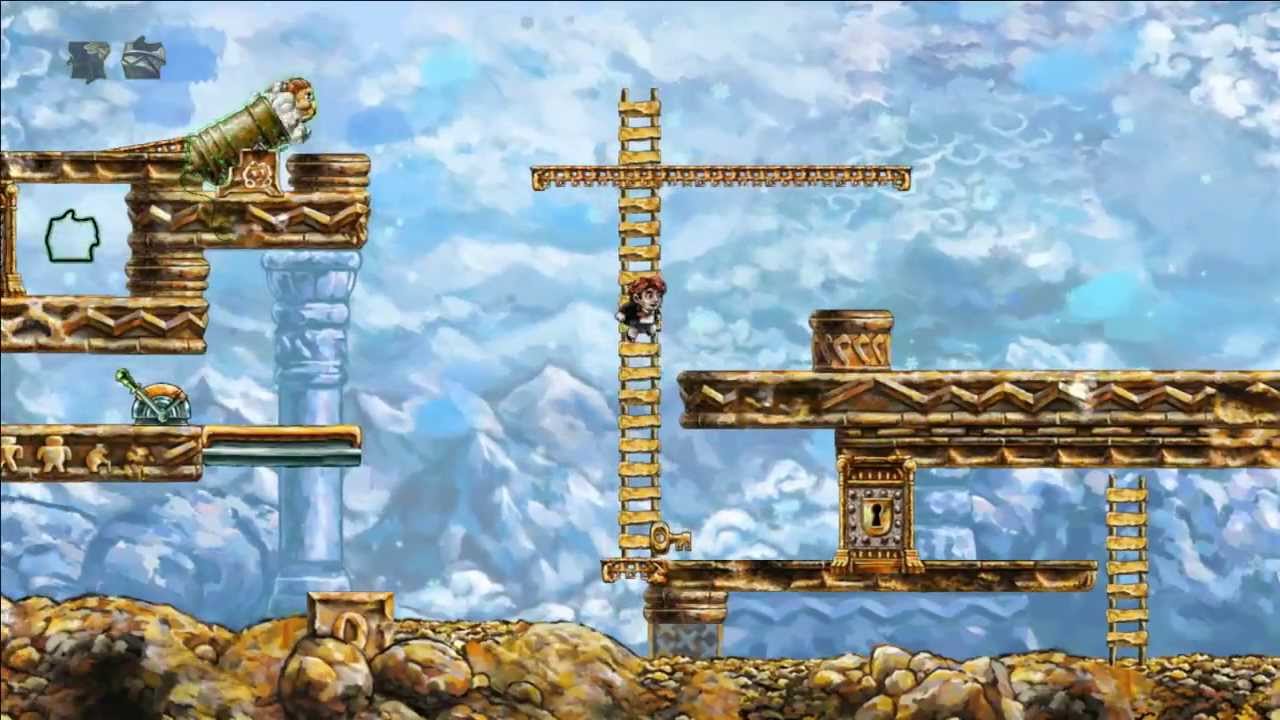
Braid, as I'm sure you know, is an indie puzzle platformer sprung from the mind of Jonathan Blow. The main mechanic this game is built on is the manipulation of time. While in Super Mario Bros, you'd fall in a hole to your death and have to start the level over, Braid gives you the power to rewind time. At the point of would be annihilation, you can rewind prior to the point you flubbed up and give it another go.
 The game is broken up into six separate worlds. These worlds are accessed via a house interior, where each door leads to one of these worlds. You only have access to Worlds 2-6 downstairs. World 1 is accessed through the attic, which is inaccessible at the beginning due to a broken ladder. You will gain rungs to this ladder as you finish all the puzzles in each world. As you enter a World's door, you proceed to a cloud scene in which there are a number of books and multiple doors present. Walking in front of each book will display text on the screen, which is about our protagonist, Tim, and a relationship that seemingly went south. Each door available leads to the individual levels of that world. In each level, there are puzzle pieces scattered about, and you must figure out how to use the environment and your ability to rewind time in order reach the puzzle pieces that are enticingly close but always seem to be just out of reach.
 My first experiences with acquiring puzzle pieces were very...let's say inefficient. I would see a piece and have no idea how to get to it. I'd try a couple things, fail miserably, and move on to the next puzzle piece and/or level. I appreciated the fact that no level really forced you to accomplish everything, or really anything, before you could leave for the next level. This was good because I wasn't really grasping the rewind mechanic at all due to my impatient mood that day.
I think I yelled, "THIS IS IMPOSSIBLE!" at one point. Then I calmed down, realized I wasn't just going to tear through this game, and started using my noodle. I had a breakthrough in which I realized the very simple concept that jumping on a baddy from a high place made me jump higher. That led to solving numerous problems, getting a bunch of puzzle pieces, and the acceptance that I was just being an impatient asshole shouting about impossibility. Figuring one of these puzzles out when it had been stumping you is a very satisfying experience. I kept having the same experience in each world where the puzzles made me feel like a fucking idiot and then a fucking genius and then a fucking idiot...
Everything in Braid tends to have a purpose. There's not really any superfluous platforms or other bits in the environment that aren't somehow involved with the puzzle. If it's there, I'm probably supposed to do something with it. This logic helped me figure out some of the puzzles because when a solution was not readily apparent, I started to breakdown all that was at my disposal, trying to figure out what purpose everything served. This exacting way he created the game world meant that everything was important but also that there was a single specific solution to every problem. There was one right way to do things, and sometimes that one way was difficult to figure out. Sometimes the timing or my position was so critical that I had to try over and over, despite the fact that sometimes, I totally understood the puzzle and how I should be able to complete it. My execution of those steps was sometimes the hinderance, and that was occasionally a source of frustration. The level "A Fickle Companion" drove me nuts for this reason. I think I consulted a Youtube video for that one because I failed so many times that I assumed I must have been taking the completely wrong track. Nah...I was right, I just needed to time everything better or stand a few pixels to the right. Infuriating.
 As I continued through each world to pick up puzzle pieces I missed, I reread the text each time. I wasn't really grasping how the text and gameplay related. There seemed to be a bit of a disconnect both with the game and the text and between texts themselves. However, I later realized that each bit of text foreshadowed the new wrinkle in gameplay that was to be added in that world. For example, the first world you enter, World 2, talks about forgiveness and learning from mistakes. This seems like an introduction to the rewind mechanic in general. In World 6, there's much talk about a ring, and the new gameplay ability involves a circle you can deploy which slows down time within that circle.
I continue to backtrack and pick up missing puzzle pieces. Collecting all the pieces in each level allows you to put together the whole puzzle for that world, and once that world's puzzle is completed, the ladder extends further to the attic. Once Worlds 2 through 6 have been taken care of, the ladder is complete, and I proceed to World 1. In order not to rob you of your aha moment here, I'm gonna be Lady Vague. World 1 is likely the most stressful. What once were puzzles meant to stare and ponder on must now be solved quickly as you rush forward to save the princess and escape the fiery inferno that blazes behind you in hot pursuit. (Accidental pun...sigh) When you make your way to safety, that's when the game changes, and your perception of events gets turned on its head. You understand your role in this story much clearer now, and I think I recall a "whoa" falling out of my mouth.
After this realization comes the epilogue, complete with more books and text, more indecipherable now than ever. What was contentment regarding this game's ending swings over to bafflement. The game is over, and I'm left scratching my head. I assume there is some deep meaning hidden in those final words that this pleb isn't going to get, so TO THE INTERNETS THEN! My biggest aha/whoa moment was that realization at the end, but Jonathan Blow contends that this wasn't the point of the game. Oh...well... Tell me what the point was, internet. What does it mean? There are lots of discussions going on regarding this topic, but Mr. Blow says we're all pretty much wrong about what the game means, but he smugly refuses to tell us what the game means because it cannot be explained with words, which is why he made the game, which, don't forget, we were all just apparently wrong about the meaning of. Great... Glad we cleared that up.
I don't think we'll ever uncover all that the creator intended in Braid, but that's okay. When one takes away meaning from a piece of art, there is no right or wrong interpretation. That was YOUR interpretation. I think that's what has always annoyed me about comparative lit or art appreciation. There's no RIGHT answer, and I have to get over that. I think Jonathan Blow needs to get over that as well.
What I do know is that guy who made this game is a clever dude. There's some very well designed puzzles in Braid. There's also some not so good ones peppered in there with one time use mechanics or "Gotcha bitch!" traps, but it's worth taking a look at. I think any game that causes this much discussion and wildly different opinions on it has to be experienced oneself. Go get your own interpretation. Dear Jonathan is not going to clue you in on which one you SHOULD have.
Tuesday, November 5, 2013
The Secret of Monkey Island: Special Edition
I love the Monkey Island franchise. I've beaten most of them, save the new Telltale Games episodes, but it's been so long, I've forgotten...you know, everything. Thus, a Special Edition of "The Secret of Monkey Island" was the perfect excuse to revisit the series.
If you've been living under a rock and know not of Monkey Island, just know that it's a point-and-click adventure game following around Guybrush Threepwood, mighty pirate...or wannabe might pirate. It's funny, awesome, inspired loads of adventure games that were to come, and you should go and play it already, you gutter-crawling cur!
Sorry, been insult sword fighting today.
What makes this a Special Edition was that they went back in and remade all the backgrounds and characters to be all fancy and drawn lookin'. They also added voice actors to do all the dialogue. While I really liked the addition of voice actors, the new art lost some of the charm for me. I wanted to experience it now as I did then. Thankfully, they gave me that option. Pressing F10 toggles between original and Special Edition looks.

 It was a very bizarre way to play this game, but each time I would enter a new screen, I would switch over to the Special Edition and take note of the updated graphics. They very faithfully recreated the old scenes, but I would immediately then switch back to the old look. It's like a comforting blanket, the old graphics. The new backgrounds looked pretty good, but I really didn't like the look of Guybrush himself. He's too lanky or something, he's got a dopey haircut, and his walk animation looked too...smooth. It was as if he floated over the ground rather than was actually walking on it. And since I'd have to look at that gangly mook the entire time, I took Mr. Pixel instead.
 I also didn't bother to figure out the new controls. The Special Edition utilized a hidden inventory and action window rather than take up the bottom half of the screen with the standard controls, but it wasn't immediately intuitive to use. It was probably designed for controller in mind, but I was using a good 'ol mouse and keyboard, and I wanted to play in old school mode anyhow, so I said fuck it.
Like I mentioned previously though, the voice acting was an excellent addition. That alone was worth the price of admission. I would walk around and use items on other items in old school mode, but anytime there was dialogue, I'd flip back to fancy schmancy mode to enjoy the audio. They brought back many of the voice actors from later Monkey Island games, which was most excellent.
If you haven't played The Secret of Monkey Island, there's no time like the present. I've loved this game for years for its existing awesome, and I love the Special Edition for allowing me to re-access that awesome without floppy disks. Kudos.


Subscribe to:
Posts (Atom)